
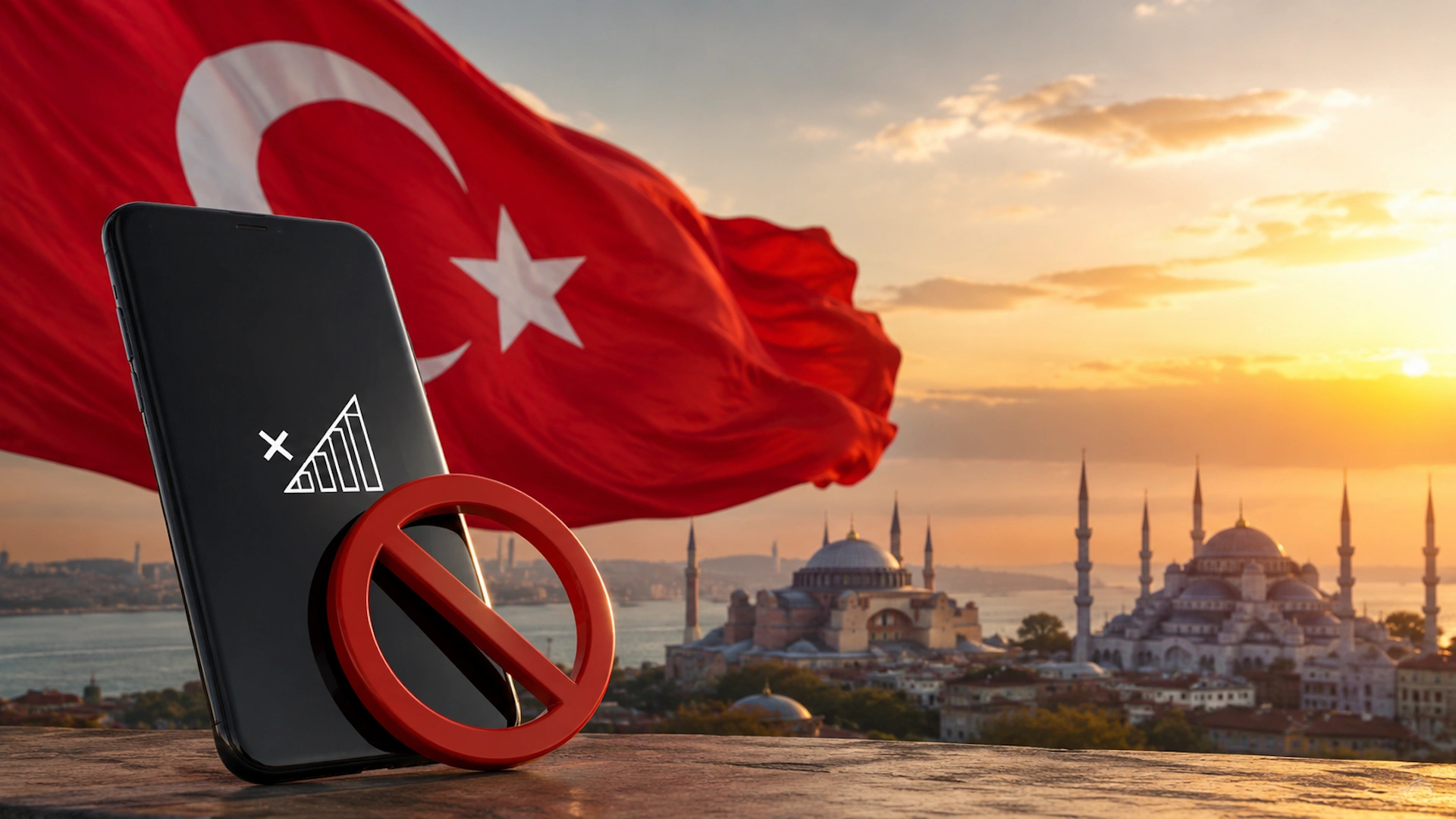
 Mobile connectivity
July 17, 202610 min
Turkey eSIM Ban Explained: What's Blocked, What Still Works
Turkey eSIM ban explained: the tech is legal, 30+ provider stores are blocked. What still works in 2026 and how to stay connected.

You are preparing a trip to Turkey and wondering how to keep an internet connection while there? Good question: most mobile plans don't include Turkey in their free roaming zone, and classic roaming there quickly becomes very expensive.
To have internet in Turkey, you can choose between an international eSIM (installed before departure) or a local SIM card purchased on-site, from an operator like Turkcell or Vodafone.
In this article, we review the price of a SIM card in Turkey in 2026, the tourist plans from the three Turkish operators (Turkcell, Vodafone Turkey, Türk Telekom), the real cost of a prepaid SIM card at Istanbul airport, and the travel eSIM solution for comparison. The goal: so you know exactly what to buy, where, and at what price, without any bad surprises upon arrival.

Here is the summary table to help you choose in 30 seconds:
| Option | Typical plan | Indicative price (summer 2026) | Ideal for |
|---|---|---|---|
| Turkcell (Tourist Welcome Pack) | 20 GB + 200 min | ≈ 1,300 to 1,800 TL in the city, which is 30 to 40 $ | The best network coverage + a Turkish number |
| Vodafone Turkey (Welcome to Turkey) | 20 GB + 750 min + 250 SMS | ≈ 3,200 TL, or approximately $70 | A local number with plenty of calls |
| Türk Telekom (tourist SIM) | 25 GB (7 to 28 days) | ≈ 1,115 to 1,490 TL depending on the point of sale | The tight budgeter who wants a physical SIM |
| travel eSIM (voilà) | 1 to 50 GB, data only | From $0.80 to $28.40 | Stay connected as soon as you land, without shops or queues |
A passport and an unlocked phone are systematically required for a Turkish SIM card, regardless of the operator: only an eSIM exempts you from this.

SOUTH KOREA
active
20 Go
remaining
Operator
SKTelecom, LGU+
Expires
In 3d • Jun 12
Top up

THAILAND
active
20 Go
remaining
Operator
AIS
Expires
In 3d • Jun 12
Top up

JAPAN
active
20 Go
remaining
Operator
NTT docomo
Expires
In 3d • Jun 12
Top up
No blocked apps
Tethering enabled
24/7 customer support
No blocked apps
Tethering enabled
24/7 customer support
Travel abroad with confidence: no more roaming fees, connection struggles, or unexpected top-ups. With a travel-friendly eSIM, stay connected everywhere, stress-free and surprise-free.
Yes, unless you're willing to rely on Wi-Fi. Turkey isn't included in most mobile plans' free roaming zone: your usual plan generally offers no included data there, and every MB consumed while roaming is charged at a high rate (or via a weekly travel pass, which is rarely cost-effective). Check your operator's terms before leaving: it's written in black and white in your pricing guide.
Wi-Fi can help in a pinch, but it's no replacement for a data plan: hotels and cafes in Istanbul offer it, but the speed is inconsistent, and you remain disconnected on the street, in transit, and at tourist sites. Yet, that is exactly when you need internet: Google Maps to find your way, instant translation at the bazaar, online museum tickets, ride-hailing apps, and WhatsApp to stay in touch with your loved ones.
For a stay of more than two or three days, a local mobile data solution (Turkish SIM card or eSIM) is therefore almost indispensable. Now, you just have to choose the right option: that's what we'll look at now.
To get an internet connection in Turkey, you have two main types of solutions. First option: an international eSIM (also called an eSIM card), purchased online and installed before departure. It is a 100% digital SIM card, integrated into your smartphone: thanks to a simple QR code, the profile downloads in two minutes, and the eSIM activation happens automatically upon landing. Second option: a local SIM card purchased on-site, at a Turkcell, Vodafone, or Türk Telekom store. It gives you a Turkish number and local calls, in exchange for visiting a store with your passport.
The way eSIMs work is becoming increasingly popular with travelers: no queues, no fiddling with tiny cards, and your usual SIM stays in place to receive your SMS (including banking codes). eSIM technology is supported by most recent smartphones, from iPhone to Samsung Galaxy or Google Pixel.
Physical SIM cards still have their supporters: they work on older phones that are not eSIM compatible, and a local number can be useful if you stay in the country for several months.
A little nuance to keep in mind: Turkey, positioned between Europe and the Middle East, is not always included in regional Europe eSIM plans. Check the list of covered countries with your provider before purchasing, or get a dedicated eSIM plan for the country: it's the safest solution.
To be thorough, two other solutions exist: rental pocket Wi-Fi (costs about ten euros per day, only relevant for groups with several devices to connect) and your operator's travel pass (rarely cost-effective for a stay of less than a month). For the vast majority of travelers, the real duel is between eSIM and a local SIM card.
Which SIM for Turkey? Three operators share the Turkish mobile network, and if you want to buy a SIM card on-site, it will be from one of them. All of them offer prepaid tourist SIM cards, sold in their official stores and at airport kiosks. The best SIM card for Turkey depends mostly on your itinerary and your budget: here are the details for each operator (Turkcell, Vodafone Turkey, or Türk Telekom SIM cards).
Turkcell is the incumbent operator and market leader: it offers the widest coverage across the country, including in the rural areas of Anatolia or Cappadocia. Its standard tourist pack (the Tourist Welcome Pack) includes approximately 20 GB of data, 200 minutes of domestic calls, and access to WhatsApp, for about 1,300 to 1,800 TL in a city center shop (recorded summer 2026). If you are traveling outside of major cities, it is the safest choice.
Vodafone Turkey offers its "Welcome to Turkey" pack: approximately 20 GB of data, generous call credit (750 minutes), 250 SMS, and easy access to messaging apps and social networks. It costs about 3,200 TL, which is nearly $70. It is the most expensive of the three plans, designed for visitors who make many local calls. Coverage is excellent in cities and in tourist areas along the coast.
Türk Telekom is often the cheapest of the three. Its tourist plans start around 1,115 to 1,490 TL for approximately 25 GB. Watch out for the trap: at certain airport points of sale, the validity drops to only 7 days, which ruins the value of the rate for a two-week stay. Always check the validity period before paying.
Before pulling out your credit card, vet every offer against these criteria. This is what separates a good prepaid SIM card from a purchase you'll regret by the third day:
These criteria also apply to an eSIM, with two differences: no passport to present, and the terms (data, validity, data sharing) are clearly stated in black and white before you purchase online.
SIM card price in Turkey: expect to pay between 1,100 and 3,200 TL in 2026 depending on the operator and the place of purchase, which is approximately $25 to $70. Three rules to know to pay the right price:
Last useful information: if you stay in the country for several months with a phone purchased abroad, Turkey eventually requires a paid device registration (IMEI tax). For a classic holiday stay, you are not affected.
SOUTH KOREA
active
20 Go
remaining
Operator
SKTelecom, LGU+
Expires
In 3d • Jun 12
Top up
THAILAND
active
20 Go
remaining
Operator
AIS
Expires
In 3d • Jun 12
Top up
JAPAN
active
20 Go
remaining
Operator
NTT docomo
Expires
In 3d • Jun 12
Top up
No blocked apps
Tethering enabled
24/7 customer support
No blocked apps
Tethering enabled
24/7 customer support
Travel abroad with confidence: no more roaming fees, connection struggles, or unexpected top-ups. With a travel-friendly eSIM, stay connected everywhere, stress-free and surprise-free.
It is THE reflex for many travelers upon arrival: buying a SIM card at the airport, Istanbul Airport (IST) or Sabiha Gökçen. It is available 24/7, vendors speak English, and activation is immediate. But this convenience comes at a high price: summer 2026 reports show a Turkcell pack starting from approximately 2,550 TL and a Vodafone pack around 3,200 TL at airport kiosks, representing a 50 to 70% markup compared to city center shops for equivalent content.
Specifically, on a 20 GB plan, the difference represents 20 to 40 $ wasted, plus the queue at the counter after your flight. If you insist on a local physical SIM, the winning strategy is simple: use the airport Wi-Fi (free with a boarding pass), head to your hotel, then buy your card the next day at an official store in town. You will find Turkcell, Vodafone, and Türk Telekom stores on Istiklal Avenue, in Taksim, Sultanahmet, and in all major shopping malls.
The other strategy, even simpler: arriving already connected with an eSIM installed before departure, and completely avoiding the airport hassle. This is precisely what we compare in the following section.
For most travelers, yes. For equivalent content, a travel eSIM costs significantly less than a tourist SIM card purchased locally, and it saves you from any hassle upon arrival. The comparison in numbers:
| Criterion | Local SIM card (physical store) | SIM Card (airport) | voilà eSIM |
|---|---|---|---|
| 20 GB / 30 days | ≈ 1,300 to 1,800 TL (30 to 40 $) | ≈ 2,550 TL and more ($55 and more) | $12.20 |
| Passport required | Yes | Yes | No |
| Queue | Yes, in-store | Yes, at the counter | None |
| Activation | In store | At the counter | Before departure, in 2 minutes |
| Turkish number | Yes | Yes | No (data only) |
| Local calls and SMS | Included | Included | Via WhatsApp and apps |
| Customer service | In-store, in Turkish or in English | At the counter | Human, 24/7 |
A point that very few comparisons mention: since July 2025, the Turkish telecom regulator (BTK) has been blocking access to the websites and applications of dozens of international eSIM providers from within Turkish territory. The initial decision targeted eight companies, including Airalo, Holafly, Saily, Nomad, MobiMatter, Instabridge, aloSIM, and BNESIM, and the list has grown since. In practical terms: once in Turkey, it is impossible to purchase, download, or top up an eSIM from these providers, as their stores are inaccessible on local networks. eSIM technology itself remains perfectly legal. We detail everything in our article on the ban on eSIMs in Turkey.
The practical consequence is twofold. One: install and activate your eSIM BEFORE departure, regardless of your provider. Two: choose a provider that is not targeted by blocking. That is the case with voilà: the website and the app work normally in Turkey, you can purchase, top up, and track your usage on-site, and your data works without restriction on the local network.
At voilà, Turkey eSIM plans start at $0.80 for 1 GB (7 days) and go up to 50 GB (30 days) for $28.40, on the Vodafone partner network in 4G/5G, allowing you to enjoy internet as soon as you land. The value for money is unbeatable for this destination: approximately $0.57 per GB on the 20 GB plan, compared to $1.85/GB at Airalo and Saily, and the displayed price is the final price, with no subscriptions or automatic renewals. There is no unlimited internet, however: voilà owns up to this, unlike Holafly which charges $3.79 per day for its unlimited plans. The eSIM is easy to install (one QR code received by email, two minutes flat) and the voilà mobile app is easy to use to track your usage or recharge during your stay. And regarding assistance, both during installation and while on-site, customer support is human and available 24/7: a real person answers you, not a bot.
Need data in Turkey? Get a Turkey eSIM!
| Plan | Validity | Price |
|---|---|---|
| 🇹🇷 1 GB | 7 days | $0.80 |
| 🇹🇷 5 GB | 30 days | 4.20 $ |
| 🇹🇷 20 GB | 30 days | 12.20 $ |
The only real limit: a travel eSIM does not provide a Turkish number. To call a restaurant or your hotel, you can use WhatsApp (universal in Turkey) or a booking app. And you need a compatible device: this is the case for almost all smartphones released since 2019. If in doubt, check in 30 seconds if your phone is eSIM compatible.
Check in a few seconds if your smartphone supports eSIM, before booking your plan for Turkey.
To decide in ten seconds, here is the verdict by profile.
You want internet immediately after landing, your smartphone is eSIM compatible, and you don't need a Turkish number. This is the profile of the vast majority of tourists: you install everything before departure, you don't have to wait in any queues, and you keep your usual SIM active for banking SMS.
Coverage is your top priority: you plan to go beyond the big cities, hike in Cappadocia, or cross Anatolia, and you want a Turkish phone number for local calls. In exchange, you accept visiting a physical store with your passport and paying the most premium rate among the three operators.
You want a local number by comparing offers in official stores: Vodafone for large call credit and urban network, Türk Telekom for the best price. In both cases, ask for the total activation price and the exact validity period before paying.
It all depends on your data consumption and the length of your stay. These guidelines work well:
A little tip for use: activate your phone's data saver mode and remember to download your Google Maps offline maps before leaving. You can easily cut your consumption in half, without any connectivity issues once you arrive: enough to travel with peace of mind, for example during long bus rides between cities. One last thing: once your eSIM is active, disable roaming on your primary SIM to avoid any surprise charges. And if you are traveling with an eSIM, install it calmly at home the day before: our tutorial how to install an eSIM shows you the steps for iPhone and Android.
For a trip to Turkey in 2026, a Turkish SIM card remains useful if you absolutely need a local number or if your phone is not eSIM compatible: in this case, buy it in a city center shop, never at the airport.
For all other tourists and long-haul travelers, the travel eSIM wins: cheaper (starting from $0.80 at voilà, offering excellent value for money), easy to install in two minutes before departure via an easy-to-use app, and with human customer support reachable 24/7 if needed. You land in Istanbul already connected, while others are queuing at the counter. 🇹🇷
SOUTH KOREA
active
20 Go
remaining
Operator
SKTelecom, LGU+
Expires
In 3d • Jun 12
Top up
THAILAND
active
20 Go
remaining
Operator
AIS
Expires
In 3d • Jun 12
Top up
JAPAN
active
20 Go
remaining
Operator
NTT docomo
Expires
In 3d • Jun 12
Top up
No blocked apps
Tethering enabled
24/7 customer support
No blocked apps
Tethering enabled
24/7 customer support
Travel abroad with confidence: no more roaming fees, connection struggles, or unexpected top-ups. With a travel-friendly eSIM, stay connected everywhere, stress-free and surprise-free.
Rony is our in-house travel-connected expert. Always curious and never too far from an airport, he explores the latest destinations while testing the newest eSIM solutions. He signs our articles on travel and mobile technology, with a single mission: to turn his discoveries into clear, reliable, and smart advice to accompany you anywhere in the world.
See all articlesMobile connectivityTurkey eSIM ban explained: the tech is legal, 30+ provider stores are blocked. What still works in 2026 and how to stay connected.
 eSIM Guides
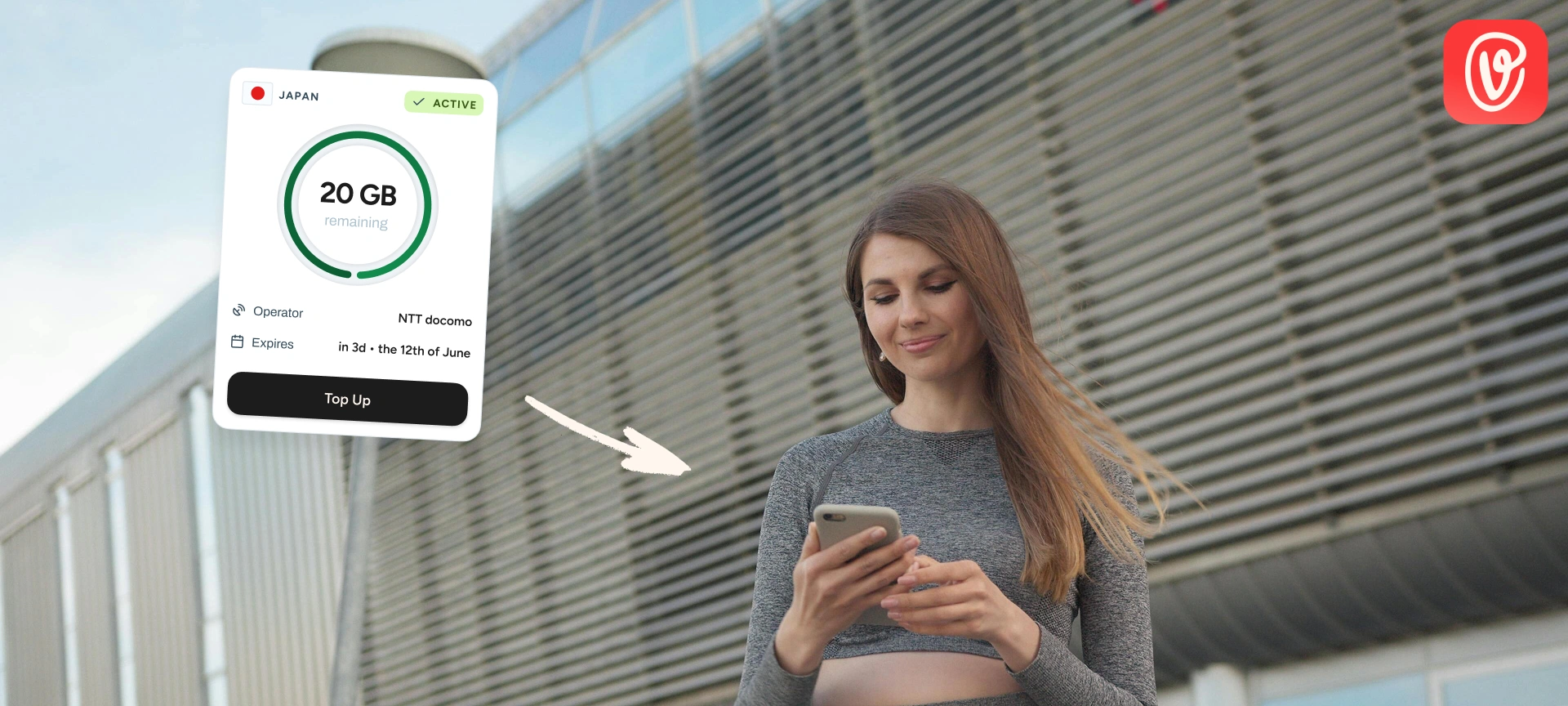
To set up an eSIM on your phone: Settings > Cellular Data > Add an eSIM Card. Installation takes just a few clicks.
 eSIM Guides
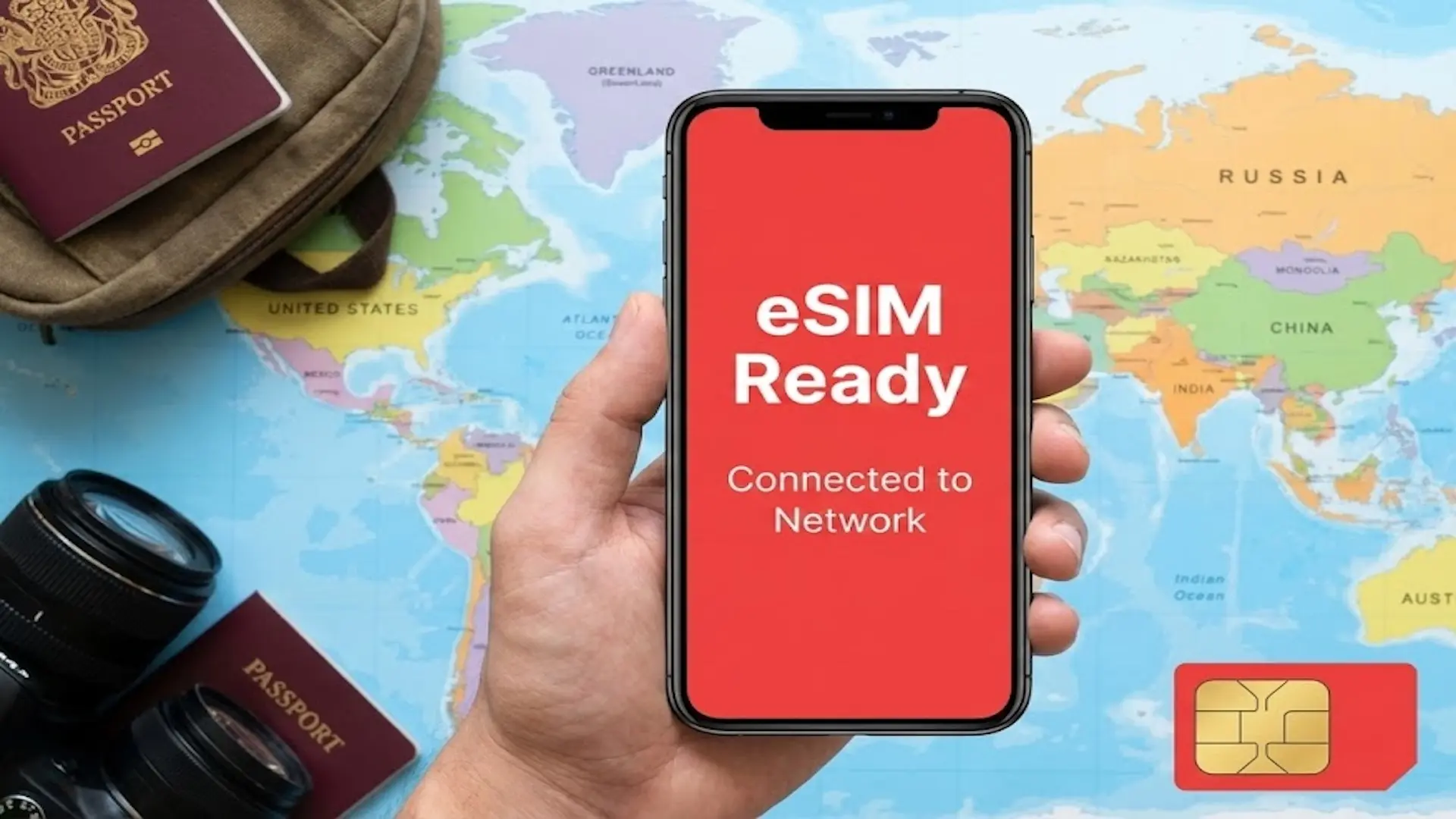
Four reliable methods to quickly check if your smartphone supports eSIM (simulator, settings, #06# code, etc.)